

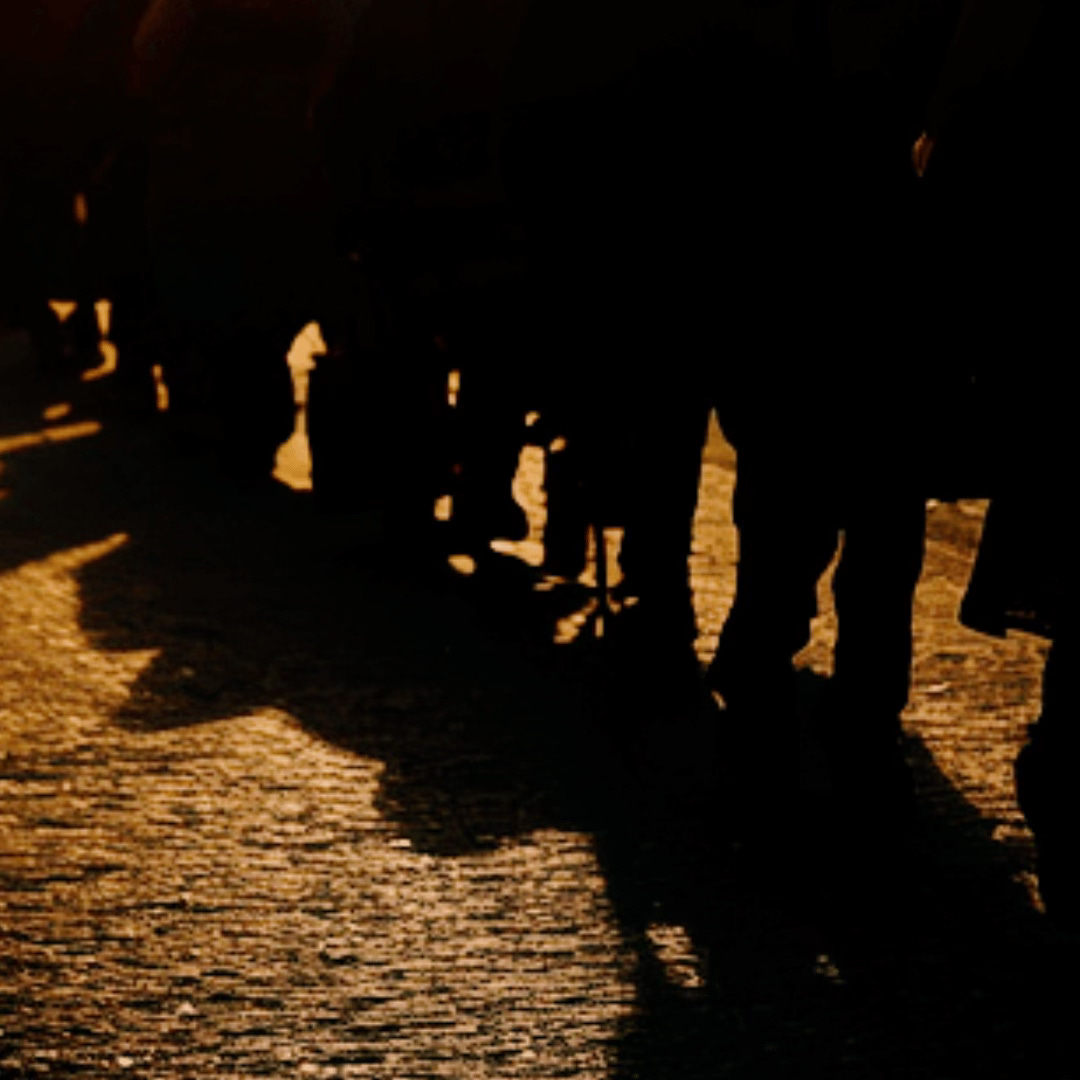
My country used to be sweet.
Words she repeated over and over in her head. Before, she had mumbled them until her lips became too parched and her throat too dry.
“My country used to be sweet.”
She had been walking with her siblings and fellow countrymen. That’s what they all could do, really. Walk. Walk until sneakers, shoes, sandals, slippers broke apart. Walk until feet were bare, bruised blue from the incessant stabbing of the gravel road.
This was not her case. Her slippers were still intact—worn, but intact. Though, if you asked her, she would prefer the stabbing. In this walk, slippers posed a hindrance, an immobility when one needed to take flight from the dangers that lurked in every corner—dangers posed by those monsters.
“My country used to be sweet.”
They had been walking in this line for days. Not a single-file line, but a line nonetheless.
“Behind the line.”
A term she and her countrymen used throughout the ordeal. Behind the line, where she could look ahead—and sometimes back—and see her countrymen for miles on end. Behind the line, where everyone moved in the same direction: toward the latest promise of safety. Behind the line, where all one had were the clothes on their backs and little else—if anything at all. Better to have nothing. Far better.
A line thick with the smell of blood, sweat and tears amalgamated, producing the worst of stench that would have easily been overpowering,
if not for the bodies.
“My country used to be sweet.”
Her eyes darted to a shirtless man by the roadside. Scrawny, lips clamped around a clear plastic bottle as he chugged the foamy yellow liquid inside. She tried to focus on him, but it was too late. The bodies stared back at her—mouths wide, eyes rolled upward into head. She knew if she looked to the other side, she would see the same.
She pressed her fingers to her forehead, trying to steady the nausea rising in her throat. The world tilted. She bit her lip hard.
“Please, not this time.”
“Keep moving Jajah. Read your protection.”
A middle sibling’s reassuring voice from behind.
She took his advice, pushing forward, offering supplication to the One above for strength.
As she passed the shirtless man, their eyes met. He looked down instantly, wiping the droplets from his lips.
She recognized him. And he recognized her.
Or rather, they recognized each other from a past life—one where she was new to the city, trying to get her foot in the door, and he a successful professional, a lawyer perhaps, tailored suits that never wrinkled. Their paths had crossed every working day in the rush of downtown—at crosswalks, outside glass buildings, in the tide of morning commuters. Close enough to notice, never close enough to speak.
All walks of that life were behind the line. Rich, poor, and everything between. The line did not discriminate or judge, and neither did those within it. The past was just that—the past. Now, one had to do what they got to do to survive.
Still, they missed it.
She, her siblings, her countrymen—they would reminisce. A low wave of rumblings that reverberated through the line each day.
What struck her most was not talk of status or national pride, but of the smallest things.
“My only wish is I never threw away that burnt rice. I’d give anything to eat it now.”
One of her siblings said it often. The others would sigh in agreement.
“Yeah.”
It was a shared longing behind the line. When the stomach gnawed without rest, the mind returned not to feasts, but to what had once been discarded.
Her world steadied after passing the man, but she continued her supplication.
She would go on behind the line—walking, enduring—with her siblings and countrymen.
It would not be until her path crossed with the pretty girl that she would stop, and begin to mumble a familiar tune.
“My country used to be sweet.”
Clad in a dirty white tank top and jean shorts, the girl stood by the roadside, her figure a stark contrast against the ghoulish backdrop.
This time, she controlled her gaze—fixed it only on the girl, nowhere else. She forced herself to see the girl as she might have been in another life: laughing and living her best life in the city—not what the road had made of her.
“My country used to be sweet.”
The girl looked at her as she passed, eyes watery, robbed of something that would never return.
It wasn’t as though she could help her. No one behind the line could.
The poor girl was already a meal on somebody’s or somebodies’ platter. Besides, they all had to follow the only rule of those wild beasts or risk death.
“Judgment day. Every man for themselves.”
“She lucky those demons did not split her open.”
A sudden headache stabbed through the center of her skull, forcing her teeth together. Memories of the last checkpoint surged forward. She squeezed her eyes shut, shaking her head as if she could dislodge the image—another pretty girl by the roadside.
That one had not been as fortunate.
No girl deserved to leave this world like that.
No human being deserved to leave this world like that.
She opened her eyes and fixed them on the source of the callous voice—a short, wiry old man with bulging eyes like grapes. He was always talking behind the line, always feeling the need to state the obvious as if they could not see it for themselves.
“Lookatdey bodies. Anyone with a hole in the chest…they eat the heart. Lord swear those animals.”
“Come across the big ones, you might have a chance. Come across the small ones, no chance. And you wey die in PAIN. My people O! Whatkinda life is this!”
His voice carried, one of many, directed at the woman walking alongside him. Her back was sharp as bone—the skeletal frame of a gutted fish beneath a thin shirt. She didn’t react; she just kept pace, eyes fixed ahead.
But the old man’s babblings couldn’t be tuned out so easily. A dark thought crept in—quiet, unwelcome, but persistent. If he didn’t stop, the wild beasts and monsters would hear him. They would notice him, take him, and silence his ruckus forever.
To wish death upon on a fellow countryman at a time like this was certainly callous for her character. Yet, she did not engage her religious side to quell the simmering hatred.
Perhaps she was simply tired—tired of his voice, of his energy, of anyone who could still speak so freely in a reality as bleak as this.
Or perhaps it was something else.
He reminded her of another old man. From long before.
An old man with kola-stained teeth, whose endless babbling had once sounded foolish—
until it wasn’t. Babblings that proved uncannily prophetic.
“See the pinkins there playing gun with sticks. This land will fight. It will fight until the whole world get tired of watching.”
“A hungry man is a angry man.”
“Grona boys today, wild beasts tomorrow.”
The memories of it all caused her to scream inside. Every day spent behind this line—this border of “before” and “after”—she was haunted by the ghost of the life she could have had. What would life be like had she never experienced this? Even if she survived, the reality of it was now permanently imprinted.
If only she’d listened to the old man. If only she’d fled before the protests and riots, when civil disobedience turned uncivil. Before the talks of revolution and freedom fighters. Before the formation of factions.
Before the drums of war shattered five generations of inequitable peace.
The “what-ifs” were a physical weight—a pressure behind her eyes that triggered the fainting spells. Many times over, her siblings were the ones who had to pull her back from the dark.
“You, girl. You, girl…”
The voice was a gnat, stinging at her consciousness. For a fleeting, honey-thick second, she was back home—reclining on the stoop as the Sunday sun dipped low, zoning out to the ramblings of that crazy old man while the neighborhood drifted by. The memory spread all over her achy body like a soothing donut grease.
But that feeling was quickly extinguished.
“Jajah. Jajah. Jajah.”
Her baby brother’s voice pulled her eyes open. The headache was back, wrapping around her skull like a constrictor. And with it—the heat, the stench, the present.
“This girl is no good,” a raspy voice muttered nearby. “She not gonna make it.”
She dropped her hand from her forehead. She found herself locked in the gaze of an old man—ragged, with the bulging grapes that scanned her until she felt peeled naked. He paced backward, the image reminding her of some sort of conjured up demon. An old, ragged demon.
“You can’t keep fainting like a small girl,” he said, snarling and revealing jagged, decaying teeth.
She glared at him like a pissed-off bull, nails biting into her palms. If this was the moment of her demise, so be it. She braced her weight, ready to lunge, but he spoke before she could move.
The words hacked at her heart. She shook uncontrollably, knees almost buckling beneath. Rather nonchalantly, he spoke those words, loud enough for everybody around to hear. Her brothers, they too shuddered upon hearing such words. If she had any doubts about their veracity, her senses would confirm otherwise.
Her eyes zeroed in on the woman beside the old demon. The woman was no longer looking ahead. Her head slumped, bony fingers repeatedly pacifying loose strands of short, dry hair.
Then came the deafening human silence. Not a word spoken. Only the crunching of gravel under journeyed feet. Only the buzzing of flies—more frenzied than before.
Then, the smell. The stomach acid bubbled in her throat as the scent of fresh blood flooded her nostrils.
There was no turning back for anyone behind the line.
As they got closer, the air began to boom with gangster rap, raw and explicit lyrics belting out.
Feet now fell in a unified trudge as labored breaths became synchronized.
Then came the sound that sealed it: a final piece to their approaching fate.
To her, it was the most loudest. The overhead snap of wings, like the heavy thwack of wet lappas against stone.
Wings of those large ugly black birds, circling and anticipating the feast that was about to commence.